Product Overview
 Blog
Blog FAQs
FAQs Webinars
 eBooks & Resources
 Partners
“We win as a team or we lose as a team.”
That’s the principle Lifetime President’s club member Scott Grates uses to open his webinar titled Building a Championship Office Culture.
It’s also a sentiment that top captive agent Freddie Villacci echoes in his own webinar, Maximizing Sales by Transforming Your Team Members From Reactive to Proactive.
Since insurance is such a commoditized industry these days, your unique office culture — the way your team members work together and relate with each other — can truly differentiate a strong insurance agency from a weak one. Find out why these two top performers adhere to this philosophy, and get their tips on how to build (and keep!) a dream team that will send your business soaring.
Why Office Culture And Agency Effectiveness Are Inextricably Linked
Office culture is crucial because your team members are the engine that keeps your agency running.
If your employees are overworked, underpaid, undervalued, or otherwise dissatisfied with their jobs, they aren’t going to feel motivated to put in much effort toward making sales and finding new clients.
“Staff sounds like an infection. Nobody wants that. You don’t have staff, you have a team.”
-Scott Grates
On the other side of the coin, both Scott and Freddie agree that happy employees are the fuel for a healthy agency “engine.” When good people are in a culture that values them and recognizes their hard work, they’re going to stick around for years.
They’ll be happy to work hard, go the extra mile (knowing the effort will be recognized and rewarded), and show up for each other when someone else needs help.
Freddie says, as a rule of thumb, “Attitude accounts for about 70% of whether you’re going to be successful or not.”
If your team members want it just a little bit more than your competitors, they’ll make sure to be the first to call when a new lead comes in, they’ll follow up just a little bit more aggressively, and they’ll try just a little bit harder to help each customer find the perfect policy for their needs. That’s why, in an industry where there might be five other insurance agencies in your region all competing for the same set of customers, highly motivated employees can be the “make or break” factor.
With that in mind, here’s how you can build a great office culture from scratch or revitalize your culture if it may have gone off track somewhere along the line.
7 Must-dos For A Strong Office Culture
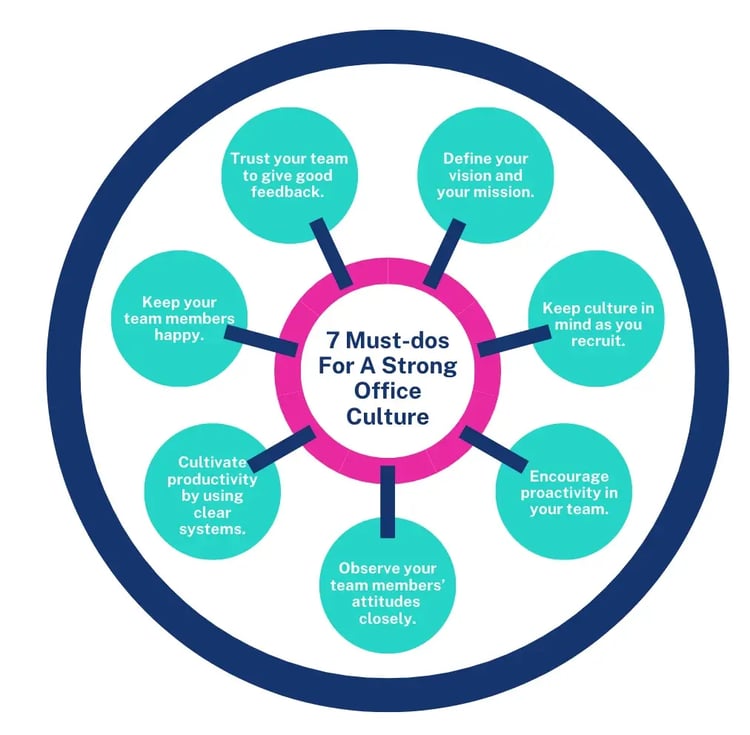
1. Define your vision and your mission.
Your mission statement is the primary objective of your agency, the vision you want to bring into reality a little bit more every single day. It’s your true North, the ideal that keeps you oriented as a team toward the same shared goals.
If you don’t have a strong mission statement that lights a fire under you or your team members, Scott recommends brainstorming aspects that make your agency different from others.
What is something other agents won’t or can’t do, that you can bring to the table to help your clients? How can you reach people on a level that’s uncommon in your industry?
Once you find your mission, put it down on paper. Scott says it’s best to review it every month or so to keep that long-term goal in the crosshairs. He also advises building roles around specific parts of the mission so that everyone participates in a clear way toward the ultimate goal. Each employee should have clear expectations around how they contribute to the company as a whole.
2. Keep culture in mind as you recruit.
“You don’t wait until your house is on fire to start running around installing smoke alarms,” Scott says. “So don’t wait to start recruiting until you have a ‘need.’ Always be proactively looking for the right people.”
Since you’re not waiting until you have a gap to fill, you can take your time and use Scott’s exhaustive hiring process that weeds out applicants who aren’t perfect for the role. He’s a fan of using multi-step tiers including behavioral assessments, phone screening, interviews, team observations, and even having applicants write a miniature business plan. This should help you understand deeply how each candidate thinks and solves problems, and it also weeds out the folks who aren’t ready for the “grind” of working in the insurance business.
Scott says, “There’s an old cliche, ‘Be slow to hire and quick to fire.’ Well, I might be the slowest ever, with the process that I use. But your team is your biggest investment, so it’s worth the amount of time we spend hiring, onboarding, and training people.”
3. Encourage proactivity in your team members.
Freddie Villacci uses a proven process to transform reactive employees into go-getters with forward-looking mindsets. He says the first step is simple: You need to be able to talk about what proactivity looks like in your opinion and describe it clearly so your team can follow along.
He recommends a couple different strategies as examples of how to break out of common pitfalls:
The Focus of Three approach
This helps combat overwhelming team members from having too many tasks to do. “I got the idea from a Seal Team Six member, one of the baddest, most intelligent, and most well-trained people on the planet. He said after three tasks, people start losing efficiency and making errors. I thought that was interesting, and then I realized if you just do the three most important things first, you’re going to outperform everyone else pretty substantially.”
Escape the Groundhog Day time loop
Do this by minimizing distractions. “If someone is sitting at a desk working, they’re going to be distracted by something every 40 seconds on average. And it can take up to 22 minutes to regain that focus once it’s gone!” Freddie says these time loops are such a huge time-sink (especially in today’s world full of smart phones buzzing away on desks) that it’s tough to gauge how much they’re truly costing you — in terms of money, stress, and even interpersonal relationship friction — until you get rid of the distractions and see how much your life improves.
4. Observe your team members’ attitudes closely.
Freddie says each team member’s performance will eventually correlate to their self-worth in a measure he calls the “personal rating.”
Freddie explains that you can’t simply ask someone how they’d rate themselves. “Many people will say ‘Oh I’m an eight or a nine,’ but the guy that messes up all the time will say he’s a ten.” That’s why you have to look at a person’s performance to get an accurate measure of their attitude and their self-worth.
Is this person willing to accept 2/10 performance from themselves when they’re capable of more? Or does that person notice when their performance is lacking and do what they can to fix the problem?
If you want proactive team members with good attitudes that mirror strong performance, Freddie says it’s crucial to pay attention to what employees accept and don’t accept from themselves in terms of effort and productivity.
5. Cultivate productivity by using clear systems.
Both Scott and Freddie feel strongly about putting clear, repeatable, and sustainable systems in place to keep your office running smoothly.
If you can put exact policies and protocols down on paper, your employees will always know what to do in a given situation, they won’t be confused or overwhelmed, they’ll feel more supported in their roles, and their results will be more consistent.
Freddie says, “If you write down your plan and then have accountability checkpoints, you’re 90% more likely to achieve your goal.”
The productivity-boosting systems you use in your business can vary based on your situation, but here are a few ideas to get you started:
- Freddie recommends tracking numerous “sub-results” like quotes given and appointments booked rather than only tracking sales. He likes to keep each of these “buckets” overflowing with activity, which naturally boosts sales without overly focusing on end results.
- Scott prefers twelve-week “sprints” rather than annual goals, because it’s easier for his team to stay hyper-focused for short periods of time. He says this has been a massive productivity booster in his agency. “During the thirteenth week we reflect on what we did well and what we can improve. If we hit our goals, we celebrate with a cookout, or bowling, or meeting at the beach.”
- Scott also likes to clearly define a “Win the Day” goal with actions that must be completed by 5 p.m. If everything is done and the goal has been met, the day is won! He says this kind of consistent daily effort is far more clear and sustainable than a vague annual goal of hitting a certain number of sales within the next twelve months.
6. Prioritize employee retention by keeping your team members happy.
Most people can admit they work for a paycheck, but regular recognition and job perks are what make people loyal to their companies.
You may not be able to offer every perk on the list below, but the more you can give your team members what they want, the more likely they are to appreciate how good they have it at your company. They’ll stay in their roles for longer and work harder because they want to keep their jobs and earn further bonuses.
Consider offering:
- Flexible schedules
- Remote or hybrid work
- Profit sharing
- Employee recognition and awards
- Financial bonuses
As Scott says, “You can’t be hateful when you’re grateful. I’m thanking my employees for all they do, even when things aren't going well.”
7. Be vulnerable and trust your team to give good feedback.
“Don’t be afraid to ask your team about ways you can improve or how you can be a better leader,” Scott says. A good leader exemplifies both honesty and humility and they’re accountable for their own actions in the same way they hold their team members accountable.
Asking for feedback opens a line of communication between you and your employees and can give you insights you wouldn’t have otherwise uncovered.
Freddie also emphasizes that you can never stop striving for a great office culture. It isn’t a one-time accomplishment; it will take continual effort to maintain and renew.
Set your happy team members loose on a list of fresh leads from EverQuote and watch your sales soar.
Building a great culture takes time and effort, but it’s only one piece of the overall puzzle. To have a strong business, you also need a pipeline full of leads who are interested in buying insurance ASAP.
Thankfully, this is one thing you don’t need to handle yourself. Just sign up with EverQuote and you’ll start receiving highly motivated leads in your target customer demographic right away. We’ll send the interested customers right to your phone line or inbox, and your team can work their magic.
Contact EverQuote here to get started.